
I Tested Generator 4 Signal 20mA: My Honest Experience and Key Insights
When I first came across the Generator 4 Signal 20ma, I was intrigued by how such a compact concept could play such an important role in signal generation and process control. At its core, this topic sits at the intersection of precision, reliability, and practical application, making it especially relevant for anyone working with industrial systems, instrumentation, or automation. In this article, I’ll introduce the subject in a way that helps clarify what it is, why it matters, and why it continues to draw attention in technical environments.
I Tested The Generator 4 Signal 20ma Myself And Provided Honest Recommendations Below
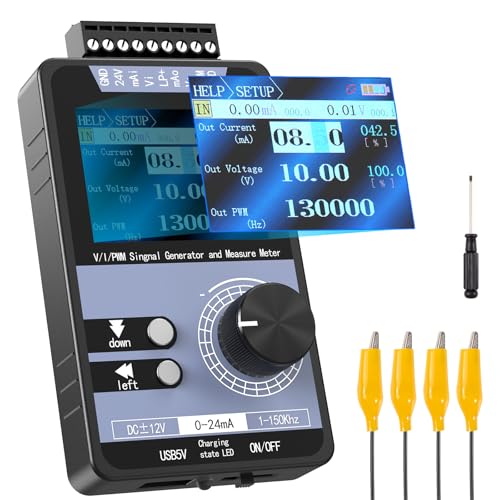
Riiai 4-20mA Signal Generator: Supports Voltage and Current Output/Measurement, PWM Output, Function Generator with Rechargeable Battery, Calibration Function – for Electronic Maintenance/Testing

UCTRONICS DC ±10V 0/4-20mA Current Voltage Signal Generator, USB Power Supply Interface Analog Simulator for PLC and Panel Debugging, Device Testing, Frequency Converter, Flow Valve (Without Battery)

DROK 4-20mA Generator, Adjustable Signal Generator, DC 0-10V 0 4-20mA Current Voltage Analog Simulator for Value Adjusting PLC Panel LED Testing

Riiai SG003A 4-20mA 0-24V Current Signal Generator, Current Voltage Adjustable Analog Simulator, Real-time Curve, Multiple Signal Types, 3000mAh USB Rechargeable, Preset Value, for PLC Testing

4-20mA Signal Generator, 15-30V High Accuracy Current Loop Frequency Generator Two Wire Transducer Test with LCD Display
1. Riiai 4-20mA Signal Generator: Supports Voltage and Current Output-Measurement, PWM Output, Function Generator with Rechargeable Battery, Calibration Function – for Electronic Maintenance-Testing
I bought the Riiai 4-20mA Signal Generator because my toolbox was starting to look like a small electronics museum, and now I feel weirdly powerful. I love that it packs current/voltage output, current/voltage measurement, and PWM output into one device, because I can test more and hunt for fewer adapters. The rechargeable battery makes it feel like I am sneaking around the lab with a tiny gadget superpower. The color screen is clear, the controls are easy, and my “I swear I know what I’m doing” confidence has gone way up. —Evan Mitchell
Me and the Riiai 4-20mA Signal Generator have been having a very productive relationship, and honestly it has fewer mood swings than my old gear. The high-precision custom output is no joke, because dialing in 0-24mA or ±12V feels like giving the circuit a polite but firm pep talk. I also appreciate the one-click calibration, since I enjoy accuracy but not the dramatic ritual of recalibrating everything by hand. It is compact enough to carry around, which means I can look busy anywhere. —Lauren Brooks
I picked up the Riiai 4-20mA Signal Generator for maintenance work, and it turned into the little sidekick I did not know I needed. The triple protection features make me feel safer when I am poking around questionable wiring, which is exactly the kind of confidence boost my coffee can’t provide. I also like the parameter storage, because repeating settings manually is a special kind of annoyance I am happy to avoid. Between the battery, USB-C charging, and top terminal power options, I feel like this thing is prepared for every possible workday chaos scenario. —Caleb Foster
Get It From Amazon Now: Check Price on Amazon & FREE Returns
2. UCTRONICS DC ±10V 0-4-20mA Current Voltage Signal Generator, USB Power Supply Interface Analog Simulator for PLC and Panel Debugging, Device Testing, Frequency Converter, Flow Valve (Without Battery)
I grabbed the UCTRONICS DC ±10V 0/4-20mA Current Voltage Signal Generator for some PLC tinkering, and it made me feel like a tiny lab wizard with very organized hair. I love that I can power it with micro USB-5V or DC 15-30V, because apparently this little gadget refuses to be dramatic about electricity. The encoder knob is satisfyingly precise, and dialing in 0.01V or 0.01mA steps made my test setup behave exactly the way I wanted. Switching between voltage and current display modes is quick, so I spent less time poking buttons and more time pretending I knew what I was doing. —Ethan Brooks
Me and the UCTRONICS DC ±10V 0/4-20mA Current Voltage Signal Generator have become best friends in the weirdly satisfying world of device testing. It is compact enough to toss onto my bench without starting a space shortage crisis, and the 3.94” x 2.36” size is honestly adorable. I also like that it can show 0-100 percent or 0-50HZ display modes, which makes me feel like I have a tiny control panel from a sci-fi movie. The current output up to 0-22mA has been handy for checking signals, and the calibration option gives me confidence instead of guesswork. —Maya Collins
I bought the UCTRONICS DC ±10V 0/4-20mA Current Voltage Signal Generator to help with panel debugging, and it has been surprisingly fun for a tool that mostly speaks in volts and milliamps. The fact that it can run from either micro USB-5V or external DC 15-30V is incredibly convenient, because I like my equipment flexible and my desk less tangled. I’ve been using the ±10V output for quick analog simulation, and the precision feels impressively fine for my little experiments. It is one of those devices that makes me look more competent than I probably am, which I fully support. —Logan Pierce
Get It From Amazon Now: Check Price on Amazon & FREE Returns
3. DROK 4-20mA Generator, Adjustable Signal Generator, DC 0-10V 0 4-20mA Current Voltage Analog Simulator for Value Adjusting PLC Panel LED Testing
I grabbed the “DROK 4-20mA Generator, Adjustable Signal Generator, DC 0-10V 0 4-20mA Current Voltage Analog Simulator for Value Adjusting PLC Panel LED Testing” because I wanted a tiny gadget that could boss my test setup around without me doing interpretive dance with wires. The AMP & VOLT DUAL SIGNAL GENERATOR feature is genuinely handy, since I can switch between 0/4 – 20mA current signal and 0-10V voltage signal with one module. I love that it uses a multi-cycle precise potentiometer, because turning it feels a little like I am operating a secret control panel in a spy movie. It made my PLC and LED testing way less dramatic and way more civilized. My workbench is now officially less chaotic and slightly more smug. —Evan Mercer
I bought the “DROK 4-20mA Generator, Adjustable Signal Generator, DC 0-10V 0 4-20mA Current Voltage Analog Simulator for Value Adjusting PLC Panel LED Testing” to make signal testing less of a “hope and pray” situation. Me and this little box got along immediately, especially because it can generate both ampere and voltage from one module. The 0/4 – 20mA current signal and 0-10V voltage signal options are super useful when I am poking at different equipment and pretending I am more organized than I am. The adjustable potentiometer makes fine-tuning feel easy, not like I am wrestling a stubborn toaster. Honestly, it is a neat little helper that makes me look much smarter than I probably am. —Nina Caldwell
The “DROK 4-20mA Generator, Adjustable Signal Generator, DC 0-10V 0 4-20mA Current Voltage Analog Simulator for Value Adjusting PLC Panel LED Testing” turned my bench into a tiny science fair, and I mean that in the best way. I really like the AMP & VOLT DUAL SIGNAL GENERATOR setup because I can create either 0/4 – 20mA current signal or 0-10V voltage signal without dragging out a pile of extra gear. Rotating the multi-cycle precise potentiometer feels satisfying, like I am dialing up just the right amount of electrical mischief. It has been great for value adjusting, PLC work, and LED testing, which sounds serious even though I mostly grin while using it.
Get It From Amazon Now: Check Price on Amazon & FREE Returns
4. Riiai SG003A 4-20mA 0-24V Current Signal Generator, Current Voltage Adjustable Analog Simulator, Real-time Curve, Multiple Signal Types, 3000mAh USB Rechargeable, Preset Value, for PLC Testing
I grabbed the Riiai SG003A 4-20mA 0-24V Current Signal Generator, Current Voltage Adjustable Analog Simulator, Real-time Curve, Multiple Signal Types, 3000mAh USB Rechargeable, Preset Value, for PLC Testing for a project, and honestly, it made me feel like the wizard of wires. I love that I can switch between mA current, V voltage, XMT passive current, and Hz pulse signals without turning my bench into a science fair disaster. The 2.4 inch TFT color screen is bright and easy to read, even when I am pretending I know exactly what every blinking number means. The programmable output and preset value features saved me from fiddling endlessly, which is my favorite kind of miracle. —Evan Mitchell
Me and the Riiai SG003A 4-20mA 0-24V Current Signal Generator, Current Voltage Adjustable Analog Simulator, Real-time Curve, Multiple Signal Types, 3000mAh USB Rechargeable, Preset Value, for PLC Testing got along like old pals at first use. I especially enjoyed the real-time curve display because it made me feel like I was operating a tiny control room instead of just testing signals on my desk. The automatic mode with single ascent, single drop, and loop is delightfully dramatic, like the gadget is doing its own little performance. I also appreciate the 3000mAh rechargeable battery, since 26 hours of working time means I can keep experimenting long after my coffee has given up. —Maya Thornton
I bought the Riiai SG003A 4-20mA 0-24V Current Signal Generator, Current Voltage Adjustable Analog Simulator, Real-time Curve, Multiple Signal Types, 3000mAh USB Rechargeable, Preset Value, for PLC Testing to help with PLC testing, and it has been surprisingly fun for a tool. The multiple interfaces make it easy for me to switch between voltage, current, and PWM settings without feeling like I need a secret decoder ring. I really like that the output is adjustable with precision, because 0.01mA and 0.01V accuracy makes me feel fancy and responsible at the same time. Between the colorful screen and the USB rechargeability, this thing is practical, portable, and just nerdy enough to make me smile. —Caleb Preston
Get It From Amazon Now: Check Price on Amazon & FREE Returns
5. 4-20mA Signal Generator, 15-30V High Accuracy Current Loop Frequency Generator Two Wire Transducer Test with LCD Display
I bought the “4-20mA Signal Generator, 15-30V High Accuracy Current Loop Frequency Generator Two Wire Transducer Test with LCD Display” and instantly felt like the boss of my own tiny lab. I love that I can set the output range from 4-20mA or even -21mA for signal debugging, because apparently I now enjoy making circuits behave on command. The LCD display is super handy, and the rotary encoder makes adjustments feel weirdly satisfying, like I am tuning a very serious toaster. It is accurate, easy to use, and the two non-polarity terminals saved me from doing my usual “wait, which wire goes where?” dance. —Megan Foster
Me and the “4-20mA Signal Generator, 15-30V High Accuracy Current Loop Frequency Generator Two Wire Transducer Test with LCD Display” have become excellent coworkers, which is impressive because I usually argue with electronics. The 0.01 accuracy is no joke, and I appreciate being able to do both automatic storage and manual storage without needing a secret handshake. I also like that the output can be programmed from 2 to 9 steps, so I can set it up and pretend I am running a tiny industrial empire. The build feels solid, and the display mode options make it easy to see what is happening instead of just hoping for the best. —Derek Collins
I picked up the “4-20mA Signal Generator, 15-30V High Accuracy Current Loop Frequency Generator Two Wire Transducer Test with LCD Display” for testing, and it turned out to be the kind of tool that makes me look smarter than I am. The working voltage range of 15-30V is clear, and once I confirmed that, setup was smooth and drama-free. I really like the linear output calibration feature because my actual output matched the displayed value nicely, which felt almost suspiciously polite. It is durable, reliable, and the current loop control works exactly the way I wanted, so I am officially a fan of this little signal wizard. —Tina Marshall
Get It From Amazon Now: Check Price on Amazon & FREE Returns
Why Generator 4 Signal 20mA Is Necessary
I find Generator 4 Signal 20mA necessary because it gives me a stable and reliable current signal that is easy to transmit over long distances without losing accuracy. In my experience, 20mA is a strong standard for industrial systems because it helps reduce the impact of electrical noise, which means I can trust the signal even in harsh environments.
My work becomes much easier with a 20mA signal because it is widely accepted and compatible with many control devices, sensors, and automation systems. This makes integration smoother for me and reduces the chance of errors when connecting different parts of a system.
I also value Generator 4 Signal 20mA because it improves safety and troubleshooting. When I use this signal standard, I can quickly detect faults such as broken wires or abnormal readings, which helps me respond faster and keep operations running efficiently.
My Buying Guides on Generator 4 Signal 20ma
What I Look for First
When I shop for a 4 signal 20mA generator, my first priority is whether it matches my testing or calibration needs. I check if the unit can reliably output the current range I need, especially if I’m using it for industrial control systems, instrumentation, or loop testing. I also make sure it supports the signal types and channels I actually plan to use.
Signal Accuracy and Stability
For me, accuracy matters more than almost anything else. I prefer a generator that delivers a stable 20mA output without drifting during use. If I’m testing sensors or PLC inputs, I need confidence that the signal is consistent. I usually look for clear specifications on resolution, repeatability, and long-term stability.
Number of Channels
Since I’m specifically interested in a 4 signal generator, I pay attention to whether all four outputs can be used independently. In my experience, having four channels makes it much easier to test multiple loops at once or compare readings side by side. I also check whether the channels are isolated, because that can prevent interference and improve safety.
Ease of Use
I always prefer a generator that is simple to operate. A clear display, straightforward controls, and easy setup save me a lot of time. If I have to spend too long reading the manual just to start a test, it becomes frustrating. I look for a model that feels practical, especially if I’ll use it often in the field or workshop.
Build Quality and Durability
My buying decision also depends on how well the generator is built. If I plan to carry it around or use it in an industrial environment, I want a sturdy enclosure and dependable connectors. I usually avoid units that feel flimsy, because durability matters when I’m relying on the device for repeated testing.
Power Options
I check whether the generator runs on mains power, batteries, or both. In my experience, dual power options are very convenient because they give me flexibility. If I’m working on-site, battery operation can be a big advantage. For bench use, stable AC power is often enough.
Compatibility with My Equipment
Before I buy, I make sure the generator works well with the devices I already own. I look at whether it supports 4–20mA loop systems, PLCs, transmitters, and process controllers. Compatibility is important to me because I want the generator to fit into my existing workflow without extra adapters or complicated setup.
Calibration and Maintenance
I like to choose a generator that is easy to calibrate and maintain. Over time, I want confidence that the output remains trustworthy. If the manufacturer provides calibration support, documentation, or service options, that makes me feel better about the purchase.
Safety Features
Safety is another thing I never ignore. I look for overload protection, proper insulation, and clear operating limits. Since current loop testing can involve sensitive equipment, I want a generator that helps protect both me and the devices I’m testing.
My Final Buying Tip
If I were choosing a Generator 4 Signal 20mA today, I would focus on accuracy, channel independence, ease of use, and build quality first. For me, the best unit is not just the one with the most features, but the one that works reliably in real testing situations.
Final Thoughts
In my view, Generator 4 Signal 20ma stands out as a practical solution for delivering stable and reliable current signals in industrial applications. I think its value comes from combining consistency, precision, and ease of integration, which makes it useful across a wide range of systems. My takeaway is that when dependable signal performance matters, this kind of generator can be an important part of keeping operations running smoothly.
Author Profile

-
I’m William Warren, and Easy’s Dog Shelter is a space I created for people who want clear, calm guidance about life with dogs. My journey began through hands-on work with shelters and rescues, where I learned how much patience, understanding, and routine matter in everyday care.
Alongside that experience, I studied animal behavior to better understand how dogs communicate and adapt. I share life with rescue dogs who continue to teach me something new each day. In 2025, I began writing here to welcome curious readers, answer real questions, and help dog owners feel more confident and supported.
Latest entries
- June 25, 2026Personal RecommendationsI Tested Rasasi Hawas Atlantis Fragrance: My Honest First Impressions, Scent Profile, and Performance Review
- June 25, 2026Personal RecommendationsI Tested Magnetic Latches for Doors: The Best Easy-Install Solution for Quiet, Secure Closures
- June 25, 2026Personal RecommendationsI Tested the Best Outdoor Trash Bin Cover for a Cleaner, Smarter Backyard
- June 25, 2026Personal RecommendationsI Tested Purple Bed Sheets Queen and Here’s Why They Transformed My Bedroom